
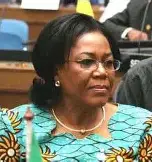
There are very few people in this world whose chance encounter with you has such a
transformative impact in your growth and development as a person. Professor Joy
Ogwu, former Nigerian Foreign Minister and Permanent Representative to the United
Nations who recently passed was one of them. I had met her at the Nigerian Institute of
International Affairs (NIIA), Victoria Island, Lagos where I had gone to invite and solicit
sponsorship from the then Director General of the Institute, Dr. George Obiozor of a
planned symposium by the International Relations Students Association (IRSA) of
Obafemi Awolowo University, Ile-Ife. I was then the President of the student body. Dr.
Obiozor was busy and could not see me and I decided to try my luck with other senior
research fellows at the institute. I saw her name at the research department as Head of
International Politics Division of the NIIA. I knocked on her door and behold she said
come in. I immediately introduced myself as a student at the Department of International
Relations at Ife. Before I could state my purpose of coming, she was already asking me
about my professors and teachers at the department. How are Professor Amadu Sesay,
Dr. Emeka Nwokedi, Reverend Fr. (Prof.) Dokun Oyeshola and Dr. Jide Owoeye? She
said Dr. Owoeye was at the institute all last week for a conference the research
department hosted on “The Economic Diplomacy of the Nigerian State”. She said “Jide
presented a brilliant paper on Japan, your department is a very good place for any
student intent on pursuing serious academic work in International Relations as you have
some of the best minds in the discipline in Nigeria”. Then, she posed the question to
me, I hope you are a good student because I will ask your teachers about you when
next they come to the NIIA, or I visit Ife for PhD thesis defense as an external examiner.
When I eventually invited her as a speaker on our planned symposium as part of IRSA
week program, she said our dates conflicts with her upcoming tenure as honorary
visiting professor at the University of London Institute for Latin American Studies.
However, she offered me a goldmine with address and contact information of almost all
who is who in Nigerian Foreign Policy establishment that we can chose from to replace
her. From that address book, I got the contact information of General Ike Nwachukwu,
former Foreign Affairs minister during General Ibrahim Babangida administration whose
office was luckily close to the Kofo Abayomi premises of the NIIA and he obliged us. But
Professor Ogwu said something very profound to me, she said I should pursue the
objective with single minded devotion as everyone was once a student and would gladly
love to participate in any capacity that would develop the next generation of leaders.
This gave an enormous boost to my morale and as she foresaw General Ike
Nwachukwu, General Joseph Garba. Former Commissioner for External Affairs under
General Murtala Muhammed’s regime Ambassador Peter Onu, former Organization of
African Unity (OAU) Secretary- General and Ambassador Adebayo Adedeji, former
Executive Secretary of the United Nations Economic Commission for Africa (ECA) agreed to be part of our student program at Ife. However, because of resource
limitations we were only able to bring General Ike Nwachukwu as Special Guest for our
student departmental association week. Professor Ogwu’s enormous faith in me came
full circle when later I was posted to the NIIA for my one-year National Youth Service
(NYSC), and she saw me again for the first time after our last encounter. I was assigned
as a youth corps member in the protocol department, but she immediately ordered that I
should be transferred to the research department as her research assistant. I remember
this encounter vividly, it was on a Friday and once they transferred me to the research
department, she personally went round the offices of her colleagues to introduce me as
their new intern and research assistant. But that was not all, as the day was rounding
up, she brought out 5 books that I should read and do a 5-page review of each book
ready by Monday. That, as all subsequent tasks were too much for a youth corper who
thought of the service year as a period for fun and youthful excitement. When on
Monday, I submitted the 5- page review of the 5 books, after going over them, she was
impressed and used the opportunity to set out a template of how I will spend my time at
the institute. She said she wants me to be good at writing policy briefs and academic
papers. And that the best way to achieve those goals is extensive reading and practice.
That I should get used to doing book reviews most weekends and master the act of
meeting deadlines. And throughout the service year, I was preoccupied with reading
different titles on different areas particularly her specialty on International Politics,
Nigerian Foreign Policy, International Organizations and South-South Cooperation etc.
But more importantly, she introduced me to writing policy briefs. She said, any student
of the social sciences, particularly international relations and political science, must
follow new developments and think ahead the policy implications for the country and
convey such knowledge through concise policy briefs to the actors, in this case your
possible principals and superiors.
I never really appreciated her rigid drive for excellence until later in my professional
career as a reporter and as a Soldier and intelligence analyst in the United States Army.
First, that address book she gave me later became my magic wand as a foreign affairs
reporter. There was no one in Nigeria’s Foreign policy orbit that I do not have access to
courtesy of Professor Joy Ogwu. The initial big interviews that I scored as a reporter like
the one with Ambassador Lawrence Fabunmi, first Director General of the NIIA, Col
Buba Marwa, then Sole Administrator of Lagos State, Sir Don McKinnon, visiting
Commonwealth Secretary General were through that. Later, when I became an intel
analyst, I saw how important the five Ws and H-who, what, when, where, why and how
Professor Ogwu’s policy briefs were in conceptualizing any problem and helping you as
an analysts make a near accurate prediction of possible outcome in any organized
endeavor. How about when I was selected to participate as a reporter in the coverage of
United States Bush-Gore elections by the State Department as part of its International Visitor Program. Somehow, there were some errors in my visa that we found out on the
date for departure to Washington, D.C. As everybody around me, were frantic and
panicking on what to do, she advised I should proceed on the journey the way the visa
is and not wait for its correction at the embassy in Lagos as suggested by many. Her
reasoning was that if I missed my arrival date, that I could also miss the opportunity or
be prevented from taking part in the program but once they discover any error on my
visa enroute that the State Department will pull every stop to correct it at no cost to me
apart from possible delay or layover somewhere in Europe. And that was how it
eventually turned out to be.
Professor Ogwu was a good woman, a great human being with a genuine generosity of
spirit, particularly her capacity to identify potential in young persons and embark on a
deliberate long process to mentor and encourage them to blossom in their own life
sojourn and pursuits. Sometimes, I cannot explain such goodness, always doing good
to others with a disarming charm and irresistible smile. All I know is that she is a devout
Catholic and once mentioned how inspirational her meeting with Pope John Paul II was.
She would end every conversation with “it is well, God bless you o”. Even when I
travelled to New York City to see her in her hospital bed, with no strength she still
retained that quiet demeanor, a certain steadiness, serenity and grace displayed in calm
quiet humor. “Kingsley, you came all the way from Atlanta to see me, it is well, God
bless you o and your family, your daughters should be bigger than me now”, she said
with a faint smile.
Professor Ogwu stood out in her abiding faith and love of country. She had devoted her
entire life to serving her country Nigeria. This manifested itself not only in her body of
work on Foreign Policy and International Economic Relations as an intellectual but in
Diplomacy as a Stateswoman. She was part of the young group of academia who made
the Nigerian Institute of International Affairs (NIIA) a bustling hot bed of ideas and
foremost Foreign Policy think tank in the 70s, 80s and 90s and eventually rose to head
the institute as its Director-General (2001-2006). She later served as Nigeria’s Foreign
Affairs Minister under President Olusegun Obasanjo administration (August 2006-May
2007) and Nigeria’s Permanent Representative to the United Nations (2008-2017).
When the Queen Elizabeth II died, Professor Ogwu was stricken with grief. She told me
that when Queen Elizabeth visited Nigeria for the first time in 1956 during her
Commonwealth tour when Nigeria was still a British Colony, she was one of the girls
who presented flowers to the Queen in Port Harcourt. Then, she was just a 10-year-old
Elementary school pupil in Port Harcourt. The other young schoolgirl who presented
flowers to the Queen at Ibadan, during that same Commonwealth tour of Nigeria in
1956 was Ms. Tokunbo Awolowo, now Dr. (Mrs.) Tokunbo Awolowo-Dosunmu. Thus, it
was with profound joy that Professor Ogwu received the Queen when she served as President of the United Nations Security Council during the Queen Elizabeth’s July 6,
2010, address to the United Nations General Assembly. She revealed to me that
protocol did not allow her to share her earlier childhood encounter with the Queen in
Port Harcourt, Nigeria in 1956.
Indeed, Professor Ogwu’s biography has been rehearsed in several places, but having
the good fortune of knowing her for over 30 years from when I became her Research
Assistant (1995), I can testify to some lesser-known facts about her. Her extraordinary
service as an undercover Intelligence agent for the Nigerian Armed Forces during the
Nigerian Civil War. She once told me she was a covert operative behind enemy lines
during the Nigerian civil war as a young woman. As a Soldier, I was surprised but the
reporter in me decided to prod her for more information on the subject but like all good
undercover agents she decided to take the account of her experiences and that part of
her life to the grave. May her sweet gentle soul rest in peace and her memories remain
a blessing.
Kingsley Dike is former Foreign Affairs Reporter with The Guardian Newspapers and
retired Intelligence Analyst with the United States Army. He was Professor Joy Ogwu’s
Research Assistant during his compulsory National Youth Service at the Nigerian
Institute of International Affairs (NIIA), Lagos.